Project Summary: Working with Time-Sensitive Chemicals
Used the CCAF model (Context, Challenge, Activity, Feedback) to design a scenario-based training that walks the learner through every phase of managing a peroxide forming chemical—from purchasing a chemical, verifying the hazards and controls, testing for peroxide formation, and disposal.
Roles
Instructional designer
Storyline developer
Performance Gap
Time-sensitive chemicals, and more specifically peroxide-forming compounds, are commonly used at Lawrence Berkeley National Lab. Chemical Hygiene and Safety has identified knowledge and performance gaps among researchers regarding their practices of controlling for hazards and effectively managing time-sensitive chemicals.
Solution
Ensure that chemical managers understand how to effectively and safely manage time-sensitive chemicals specific to the following objectives:
Identify time-sensitive chemicals
Make appropriate purchase decisions
Label and store these chemicals appropriately
Monitor and inspect containers
Safely dispose of peroxide-forming chemicals
Design Highlights
Used relatable work scenarios that allow the learner to explore and apply safety guidelines when working with peroxide-forming chemicals.
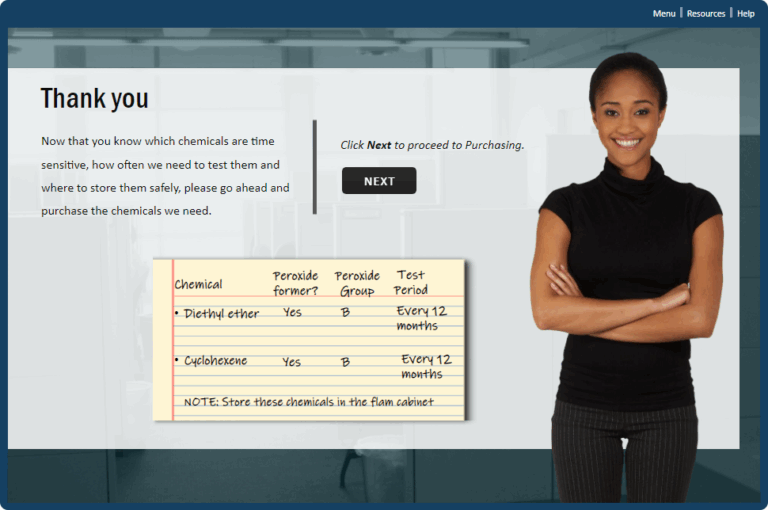
Provided job aids that the learner can use in the field given the time between training and real-world application.
Applied the CCAF model to each learning activity
Click through the sample images below.
Activities designed around a workplace scenario with relevant challenges.
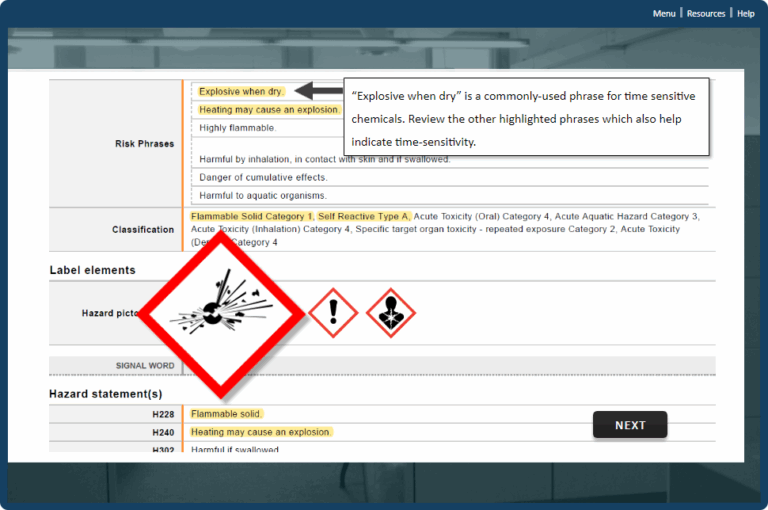
Activities review foundational skills like reading labels for hazardous indicators.
Activities reinforce safe practices such as reviewing SDS sheets for more accurate information.
Through a series of activities, learners assess and determine complex conditions that reflect real challenges in the workplace.
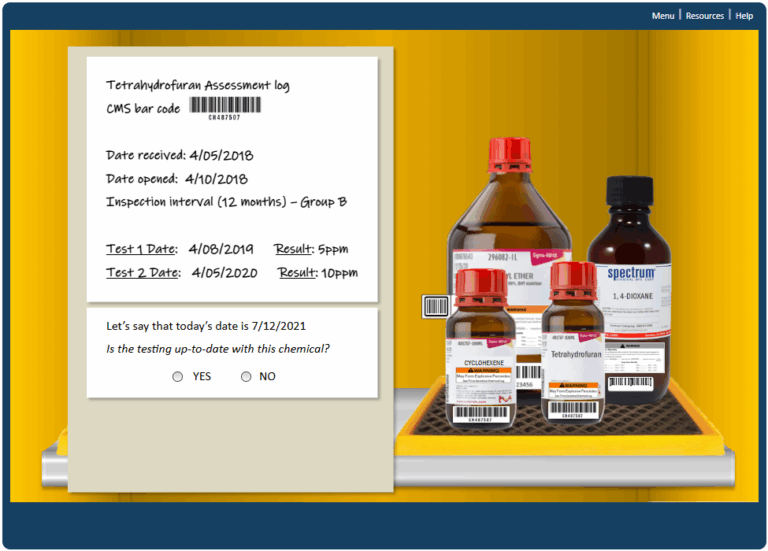
Learners complete simulations where they analyze conditions and make determinations as shown in this activity for determining if peroxide former testing is needed.
This clip shows an interactive activity where the learner tests for peroxide levels in a container.
This activity reflects the workplace condition of reviewing peroxide-forming chemicals in a storage cabinet and determining if testing is needed.